The Polestar 4 is a technology-filled Coupe-SUV, which is as big on design, as it is on its quirks. But that is what you’d expect from the design-heavy Volvo offshoot
Singapore – If you are unfamiliar with Volvo offshoot, Polestar’s nomenclature, you’d probably think that the Polestar 4 is a model up from the Polestar 3. But the Coupe-SUV actually sits between the two cars, although by footprint, it is almost the same size as the Polestar 3.
For quite a while since the brand’s introduction here in late 2021, Polestar was a “one car pony”. The compact Polestar 2 – essentially a raised liftback, was offered in a few variants, so to satisfy various needs. From a Performance Pack model, where Swedish Gold was introduced to us, via its many special fixtures. There is also now a ‘Core’ base variant, which I came across recently at their showroom. This example is without the full-glass sunroof, while its electric front seats lack electric recline adjusters. Now with a three car line-up, Polestar has more to offer for a wider audience. Sorry I digress.

A Necessary Idiosyncrasy
It is not only by design that the Polestar 4 differs from the 3. Interestingly, while the latter is built upon the Volvo-derived SPA2 (Volvo Scalable Product Architecture), which also underpins the Volvo EX90 and future Volvo ES90, the Polestar 4 on the other hand, sits on its Geely parent’s SEA (Sustainable Experience Architecture). Another variation of this SEA underpins the Zeekr X, Volvo EX30 and Smart #1.

At the front, the Polestar 4 exhibits one of just a few hints of its Volvo roots. Its Thor’s Hammer headlight interpretation, now a dual-blade design, splits what is visually the bumper area from the rest of the car. Beyond the fancy headlight design, most of the Polestar 4 seems to be as normal as it can get. Whichever way you look at it, it is wide, and therefore it carries a certain presence.

I like that designers went to town with the sculpting of the doors. I can almost visualise them generously removing material during the clay modeling stage, where the deep gouges break any would-be monotony; while visually adding a little lightness to the 4’s design. But with an almost 3-metre wheelbase, the rear wheel almost seems slightly out-of-place, when viewed in relation to the rear of the car.
The necessary idiosyncrasy here is the lack of a rear windscreen, and in its place, a pressed metal panel. The big ‘WHY?’, I will get to in a bit.

Space Oddity
While the interior of the Polestar 4 differs significantly from both the 2 and 3, it stands by the same design cleanliness as one of its pillars. This example is optioned in Zinc Nappa leather with Charcoal Deco, which I prefer over the Charcoal only interior.

For the driver, there is a 10.2-inch digital instrument panel, which is further supported by a 14.7-inch windshield-projected head-up display – the latter aids in keeping your eyes on the road.
Unlike the 2 and 3, the Polestar 4 bucks the trend of a portrait-style infotainment touchscreen, in favour of a landscape format 15.4-inch unit. But like its sister cars, the infotainment is powered by Google’s Android Automotive. Hence those with Google-based home automation will find this a huge advantage. As for voice recognition, Google Assistant adds to quite a seamless experience, especially while you are driving; since you are able to call up Spotify or YouTube music playlist, or even set navigation without taking your eyes off the road. Much of the graphics is created with a heavy emphasis on Typography, which to me is an absolute wet dream for any visual arts designer.


For the 4, Polestar has also included ambient light colours, presented to you in a celestial theme. So you can choose to bask in the red-orange glow of the sun, or even under the cool-blue of Uranus. Front occupants get the best spot in the car in my book, since they have ventilated seats with massage (only available with the Nappa leather optioin).
Interestingly, there is also a pet mode, where the car can be set to remain ventilated until you return. With this turned on, the infotainment displays a robot dog icon, with an indication that its owner will return soon.

While most things are well-thought through, I would have appreciated that Polestar had stuck with regular air-conditioning vent adjusters, instead of servo-actuated ones which you can only adjust with the touchscreen.

At the rear, passengers can enjoy the comfort of reclining seats, which can be adjusted via buttons on the central armrest, or from the touchscreen at the tail of the centre console. Unfortunately if you do need to tweak the climate control, you only can do this via that same touchscreen, which takes some effort, if you are already reclined.
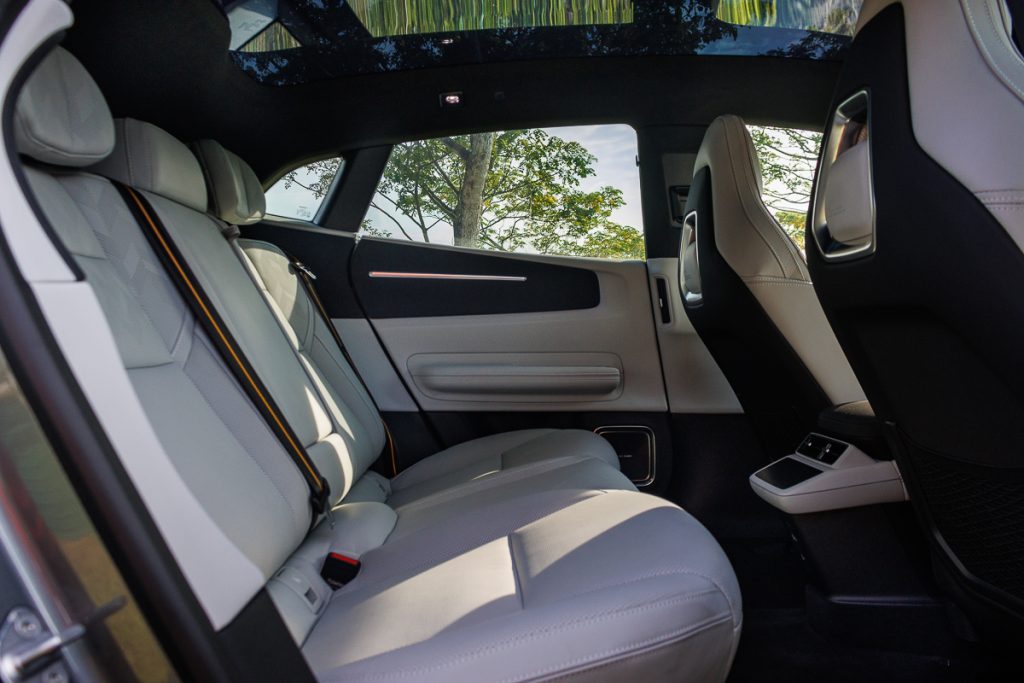


Since the roof of the Polestar 4 slopes down quite dramatically at the rear, there would be very little you can see out of, if Polestar made the decision to install a rear windshield (a design element first seen in the Polestar Precept). A tiny advantage for those at the rear, would be that it feels rather cocoon-like, thanks to the blacked-out removable back panel.
As for versatility, the boot at 526 litres is quite decent. Just for contrast, the BMW X3’s is 570 litres, while the Tesla Model Y, would simply swallow with its 854 litre behind.


Reflections of My Ride
This Dual-Motor variant puts out 544hp (400kW), and 686Nm, which is a little more than twice the output of the Single Motor version. There is no other way to say this that it is properly quick, where getting from nought to 100km/h is achieved in a grey-out inducing 3.8 seconds. Acceleration with your foot down, is best described as a brief introductory feed of torque to prime your mind, which then develops rapidly into a brutal plastering into your seat.
Easily weighing over 2,300 tonnes, this Dual Motor variant is a heavy car. I quickly can tell that the ZF-sourced continuously controlled active dampers have their work cut out for them. While on their stiffest setting, I sling the slope-roofed SUV into a turn, and right away, body lean is kept in-check. The suspension, fighting hard against the strain generated by the sheer mass of the battery, is still surprisingly able to communicate what the wheels are doing. At a stretch, I do note a slight bet of clumsiness at times, but dialing-in such nimbleness with this amount of heft is no mean feat.

Away from milking the Polestar’s high-end performance, what is more important is that it delivers well on Swedeness, smoothness and comfort. All this while having enough of a hushed interior, which I feel, would satisfy most drivers. Perhaps the one thing that you would need to keep taking into account of, is the car’s deceptively long wheelbase, when executing tight turns.

Det är den Berömda Elefanten i Rummet – Something About That Famous Elephant
But there is that elephant in the room we have to address. The lack of a rear windshield, due to how the car is packaged, does bring about some inconveniences. So in-place of the rear windshield and an actual rear mirror, the Polestar 4 relies on a rear-view camera, where it transmits the video feed into a screen; the latter which is embedded into what would be the rear-view mirror. This is akin to solving a problem, which was unnecessarily made in the first place… A case of shooting yourself willingly in the foot, and then fixing things with a bandaid.

Throughout my time with the car, I never got used to this tech-heavy combination, simply because your eyes need to make adjustments to the near focal length of the screen, each time you need to check the rear. This can prove to be tricky when attempting to change lanes in heavier traffic. However, I do admit that I do get a bit of a cheap thrill, observing the frowns from the various drivers who happen to stop behind the car at the lights.
Perhaps, Too Much is Really Too Much?
WIth its dual motor setup, this Polestar 4 variant averages out 590km of WLTP range, which is only 30km less than the Single Motor variant. For sure, this is a small price to pay for an additional motor, which gives you access to eye-watering performance. But while I can say that the added grunt is a welcome treat, all that excitement might quickly wear out, since you’d not be utilising most of what this setup brings to the table.

What also gets to me, is the $5,744 you’d need to cough up each year to the tax man, for all the filtered dinosaur goo you did not directly burn. This also makes the Single Motor variant’s yearly $2,090 so much more palatable. Perhaps in this case, the Dual Motor car could be just a little over-the-top?
Words & Photos: Clifford Chow
| Pros | Cons |
|---|---|
| Too quick, decently-good handling | Too expensive |
| Well-sorted infotainment, luxurious interior | Should have factored in a rear windshield |
| Decently versatile | Needs manual vents up front, and armrest-located touchscreen at the rear. |
| Drivetrain | Full Electric |
| Layout | Dual Motor, All-Wheel Drive |
| Motor power / torque | 544hp / 686Nm |
| Battery capacity | 100kWh |
| Efficiency | 21.7kWh/100km |
| Electric Range | 590km |
| 0-100km/h | 3.8 seconds |
| Top Speed | 200km/h |
| VES Band | A1 |
| Dealer | Wearnes Automotive |
| Price | S$380,000 with COE and VES |
| Verdict | Stylish, quirky, powerful. Perhaps too quirky? Single Motor variant might be the way to go. |