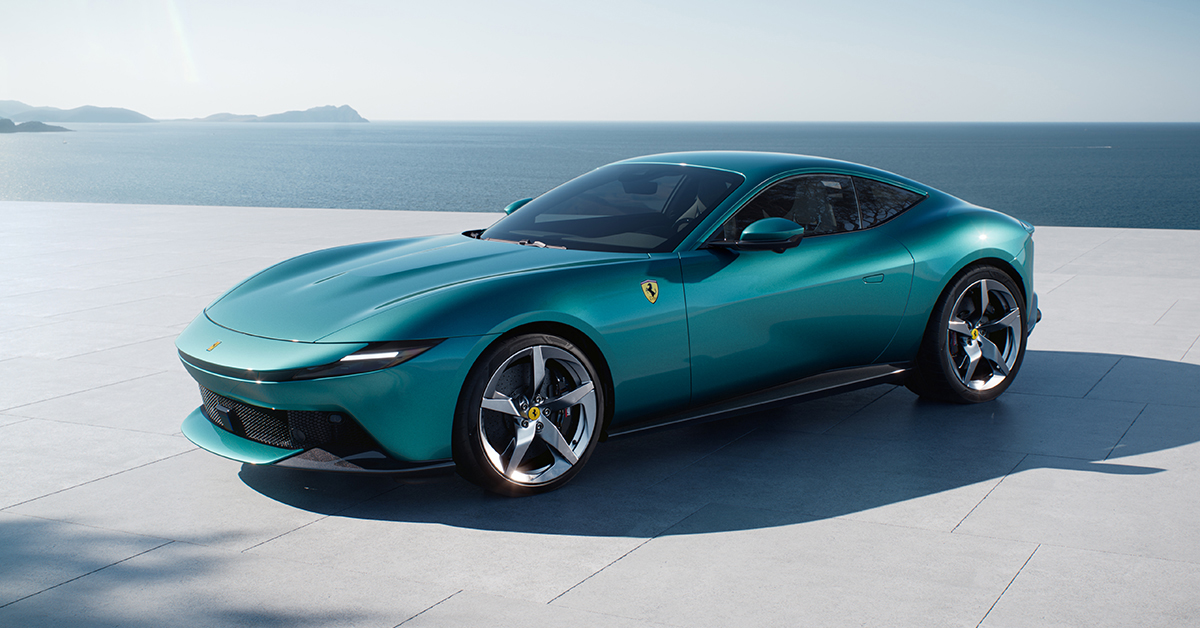


A worthy successor to the Roma, or nothing more than a mild facelift?
Amalfi – Portofino, Roma, and now Amalfi. Ferrari’s really gotten into the groove of naming its cars after Italian cities, as this southwestern town has been chosen as the name for their latest interpretation of Ferrari’s coupé berlinetta Grand Tourer. With both a fresh face and increased power, the Amalfi replaces the outgoing Roma in the marque’s contemporary line-up, and is aimed at those who wish to experience speed without forgoing comfort and relaxation. The Ferrari Styling Centre team took inspiration from the Roma’s design language, resulting in a more striking and modernised appearance while still retaining the Roma’s overall aesthetic.

Most prominently, the front end drops the Roma’s traditional grille, and instead has a body-coloured wing above a dark recessed band that elegantly integrates its headlights and sensors. The back features a wide aerodynamic diffuser, while the rear screen meets an elegant spoiler profile.

With an evolution of Ferrari’s twin-turbo V8 that now produces 640hp (20hp more than the Roma) due to new turbocharging calibrations, Ferrari has stuck to its roots while still opening the door for innovation. Its century sprint in 3.3 seconds may not seem lightning quick by today’s supercar standards, but Ferrari grand-tourers have always been more about the driving experience than chasing numbers. Keep your foot down and you’ll eventually reach 320km/h.
A range of technical tweaks has also resulted in quicker throttle response and a more consistent power delivery, while enhanced torque delivery now results in stronger pull at mid and high revs throughout the gear range. The Amalfi also has the eight-speed dual-clutch transmission soaked in an oil-bath, first seen in the SF90 Stradale. However, this now features a more powerful control unit that is better integrated with the engine software, resulting in quicker and smoother gearshifts.


On the interior, you’ll be pleased to know that the soulless and overly complex touch-capacitive buttons on the steering wheel are no more. Instead, it has been redesigned to feature physical buttons again, including the iconic red start button. dual-cockpit layout

The Amalfi’s infotainment system is separated into three displays. A 15.6-inch instrument cluster provides driving and vehicle dynamics information, while a 10.25-inch centre capacitive touchscreen that features key functions: multimedia, radio, phone, screen mirroring, climate control, seat adjustments, and vehicle settings. The passenger side hasn’t been neglected either, as an 8.80-inch passenger allows the one riding shotgun to view crucial vehicle information such as G-forces and engine revs.

If you ever get sick of the V8 rumble (which you probably won’t), you can include the optional Burmester® premium audio system that provides an immersive audio experience with 14 speakers and 1,200 watts of power.
The integrated central display and ergonomic controls ensure a seamless and integrated driving experience while carbon fibre and contrasting stitching give the interior an elegant and luxurious feel. Furthermore, the Amalfi’s practical 2+ configuration allows the rear seats to be used either to store your essential groceries on supermarket runs, or sit your less essential children on school runs.

For those with a phobia of speed bumps, they can opt for a front lifter system that raises the car by up to 40mm at speeds not exceeding 35km/h.
The price and availability of the Amalfi in Singapore haven’t been revealed just yet, but if you’re a lucky Roma owner who’s thinking about an upgrade, there’s no better car for you.
Text: Tan Kai Wyn
Photos: Ferrari