


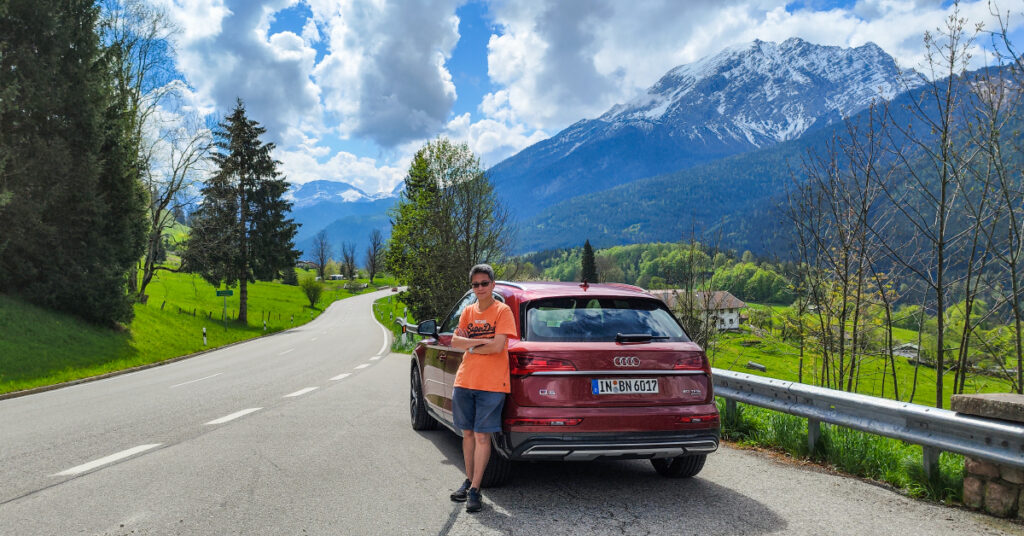
Our Chief Ed embarked on a 2,670km road trip through Germany, Salzburg and Czechia, and even chundered in-front of Berlin’s Brandenburg Gate.
Here is his story… I mean his itinerary
Europe in spring is an excellent season for a traveller to take in its sights, sounds and flavours. The weather is mild, and with the sun finally breaking through what is left of the past season’s cloud cover, it casts a beautiful light on the places you’d be visiting.
A while ago, I took a trip to Munich for work, and then went on to explore the region. What ensued was a 2,670km self-drive holiday (and a long-term test drive in a previous life) to the following destinations.
Lindau | St. Gallen | Zugspitze | Füssen | Königssee | Salzburg | Cesky Krumlov | Hluboka | Prague & Kutna Hora | Lübbenau | Berlin | Rothenburg ob der Tauber | Munich

Lindau – the island with the lion sculpture and Bavaria’s only lighthouse
A town on an island, located along the Eastern shore of Lake Constance, and about a two-hour drive from Munich Airport, Lindau is a popular destination among tourists.

Setting-off from Munich Airport in the morning on the A96, our trusty transport was the Audi Q5 2.0 S Line 40 TFSI, which was great, since it provided me with ample space for my 2 weeks worth of luggage. Its adaptive sports air-suspension would also prove its worth in how the car handled over my days of traveling; and just as important to providing me with its comfort and handling sweetspot, I could lower the Audi SUV’s rear end, whenever I needed to lift heavier bags into the boot, or retrieve them.

I made a stop at a fuel station to purchase an Austrian Vignette. This is essentially their version of road pricing for highways. They come in denominations of an annual pass, a 2-month, a 10-day and a single-day pass. Since I knew that there was a possibility of straying over the border earlier in my trip than expected, I purchased a 10-day pass – something which would come in handy very soon.
Tip: Austrian Vignettes can be purchased at German fuel stations along highways which lead into a neighbouring country, or online.

Since I did set off in the morning, my arrival to Lindau was way too early for checking in. So it was over here that I decided that since I already had my Austrian Vignette, I could hop over the border to Gasthaus Seibl Fam. Bayer for lunch; a place which was highly recommended by someone from Audi Germany, who often cycled up this highland.

The restaurant, which is located on a highland South of Lochau, offers a commanding view of Bergenz with its harbour, and in the distance, a little bit of Switzerland. The region’s spring brought with it, seasonal wild garlic. When made into a soup, topped with a dollop of butter, it is quite heavenly. I had been having countless servings of this during my prior work trip, and I could safely say that I formed a habit.


Tip: Find what seasonal foods are available. You might get a pleasant surprise.
With lunch done and dusted, we made our way down the slopes, crossing again into Germany, and back into Lindau. With a history of over a thousand-years, and named after the linden tree, the town of Lindau sits on a tiny island within Lake Constance. The place is easily remembered by its most iconic landmarks – its Lion Statue and lighthouse (the only one in Bavaria), which sit at the mouth of its harbour.

At the lake promenade, there is a good scatter of cafes, where you can spend your time watching the occasional street performance from, or the ferries returning from Rorschach, Switzerland, as they enter the harbour.

The Mangturm, or Mang Tower, which is located along the promenade, formed part of the town’s fortifications, back in the day. While the old signalling post was closed when I was there, from May to October, from 10am to 6pm, you can enter and climb the stairs of the square tower, where you will be rewarded by a commanding view of the town and the waters of Lake Constance. There is a Rapunzel’s braid which hangs out from one of the windows; which is in reference to the Fairy Tale Hour for Adults, which happens on Friday evenings.


The historic old town hall or Alte Rathaus, along Maximilianstraße, is in my books, best visited early in the morning, if you want an opportunity for an unobstructed photo. Built in 1422, it was briefly at one time, the region’s parliamentary building. The richly painted facade is adorned with colourful murals and a clock. If you were to look carefully, you might even spot a few details depicting the said Reichstag.

A day trip to St. Gallen
Since Switzerland was across the pond, I decided on a day trip to visit the city of St. Gallen. The ferry tickets can be bought online here (though I find the site rather buggy), or at a counter located on the outside of the Lindau train station itself.


With clear skies, calm waters and the cool spring weather, the journey is best savoured with a slice of Apfelkuchen and Spezi. Once at Rorschach Harbour, I found that the quickest (and laziest) way to St. Gallen was via the S7 or S25 trains, to “backtrack” a stop to the main Rorschach train station. From there, there are four trains, IC5, IR13, S4 and S5, which will take you to your destination.


St.Gallen is a city with an eclectic mix of new and old. With many of the attractions within walking distance from the train station, its Abby District is the town’s largest draw. Awarded UNESCO World Heritage status back in 1983, it is home to the world-famous St. Gallen Cathedral. The present building, which dates back to 1755, is designed in the Baroque style, and is richly decorated with frescoes on its ceiling. Take it from me, it is worth spending a bit of time within the Cathedral to admire these paintings. The Cathedral also houses the most complete set of church bells in all of Switzerland.

Within the same compound, you can also pay a visit to the famous Abbey library of Saint Gall. Designed in the Late Baroque style, the library carries publications dating back to the 8th century. An interesting fact, it is also home to an Egyptian mummy.


I was also fortunate enough to stumble upon a flea market at the Gallusplatz. The location, which is marked by a linden tree and a fountain, is beside the West entrance of the Cathedral. Between April and November, the flea market will be up on the first Saturday of each month.
Due to time constraints, the one place I did not have a chance to visit was the Roter Platz or Red Square, which is designed to be an open-air “living room”. Created by Spanish artist Pipilotti Rist and architect Carlos Martinez, the surreal, almost Dali-like installation features public furniture and floor area coated in red.

For those who prefer more traditional and less quirky architectural pursuits, the town is dotted with 111 bay windows… So happy hunting.

Back to Lindau for Dinner
If you are a bit of a car buff, here is some good news. Eilguthalle is a restaurant which sits just beside where the railway tracks terminate, and along the West side of the harbour. Not only do they update their menu frequently, but the restaurant is also home to a car storage and showroom. Over here, I actually found a rare four-door VW Käfer Type 18 (Beetle) built by Austro-Tatra.


Shooting for Zugspitze Before Backtracking to Füssen
The next leg of our trip took us eastward towards Zugspitze – Germany’s highest mountain. However, I had to pass Füssen, which was one of my intended stops in my itinerary. Zugspitze, which was further East, only had that one available day, that their cable car would operate, while I was within reach.

Since I set off early in the morning, Bad Hindelang, a town which is about an 80 minute drive from Lindau, would be my choice stop for breakfast. After which, what lay meters ahead were the inviting uphill twists and turns of the Jochstraße; which is where the Jochpass Oldtimer Memorial Hill Climb event takes place each year.
Since the Audi Q5 I was driving was equipped with an adaptive air suspension, a flick into Dynamic driving mode stiffened the dampers, priming them for what lay ahead – a squiggle of turns, if seen from above, would be reminiscent of the unprovoked ooze from a tube of thick ointment. The single carriageway, built for a time where vehicles were narrower, is riddled with blind corners. While it is entertaining, caution has to be exercised when navigating this route.

The Austrian Vignette, which I had purchased at the beginning of my holiday again came in handy, as taking the E532, brought me through the Grenztunnel Fussen, and out the Fernpass Straße, where the latter was on the Austrian side. An hour-and-a-half after leaving Bad Hindelang, I was at the foot of Germany’s highest peak.

Rising almost 3 km above sea level, Zugspitze is a must, if you are in the area. The mountain is home to one of the last glaciers in Germany, and also has 20 km of ski runs; the latter which are ideal if taking to the slopes are your thing.

OverI boarded the ‘Cable car Zugspitze’ – one of three cable cars which service the mountain, and the only one which reaches the top. From the open air viewing gallery a good day, you will be able to view mountain top after mountain top as far as the eye can see.


A planned stop for what was possibly the world’s highest schnitzel lunch, at the restaurant below the viewing deck, and a customary visit to the souvenir shop, ended my visit to the top of Germany.

After descending, I paid a visit to the green-tinted Eibsee, which is located right beside the car park. If you do have more time (and energy) on your hands, the lake offers boat rentals.


Füssen and Neuschwanstein Castle
A little recap here – I mentioned earlier that I had to travel further eastward from Lindau to Zugspitze, essentially passing Füssen. This was because after a few rounds of planning, I realised that that was the only available date window, where the cable car would be in service.

Füssen, which sits just off the border from Austria, would be an hour’s drive back West, and where we would spend the night. Its old town, with its shops and restaurants, is excellent for a relaxing stroll in the evenings.
I settled for dinner along the Reichenstraße. Just across from me, the Stadt-Apotheke, with its very beautifully-painted facade, and Renaissance elements, would form a beautiful backdrop to end the day.

One of the key factors which affects my decision making when booking a place to stay, would be access to free parking, and even better, one which is nearby. The Maurushaus, which I stayed at, was ideal, since I had my own lot just across from the main door.
Tip: Check fuel prices if you plan to cross any borders, or if you are near the border with another country. For my trip, fuel in Austria and Czechia were cheaper. Hence some planning can help you save on cost.
The main highlight for coming to Füssen is my visit to Neuschwanstein Castle. Getting there is about a 10 minute drive, or if you choose to leave your car in town, it is also reachable via bus number 931 or 9606 from Füssen. As you are only allowed to park at the carpark at the base of the hill, the castle is a 1.5km trek uphill (I must emphasise that this is going to be quite a steep climb), which would take you close to an hour. If you want the easy way out, there is a horse carriage service available, which costs €8 uphill.
However, you will still have to climb from the stop to reach the castle. As I thought I could save myself a few Euros, there are no prizes for which option I took.

Neuschwanstein Castle was commissioned by King Ludwig II of Bavaria, as a personal retreat, and also to honour his favourite composer, Richard Wagner (of Flight of the Valkyries fame). Another reason for its construction, was that King Ludwig disliked being in the public eye.
One of the key highlights is the castle’s Singers’ Hall. A favourite of the king, but rather than being made for concerts, it depicts scenes from Wagner’s “Parsifal” and “Lohengrin” operas, and romanticised stories of knights from the Middle Ages. From the balcony of the Throne Hall, you will be able to catch a glimpse of Hohenschwangau Castle, the childhood residence of Ludwig II.

An interesting fact is that the Neuschwanstein Castle was never completed. During the Second World War, it also became storage for stolen art. Fortunately, the castle escaped damage, due to its remote location. Later on, it served as the inspiration for both Disney’s Sleeping Beauty and Cinderella castles.

For that picture postcard view of Neuschwanstein Castle, with Schwangau village in the background, you may want to pay a visit to Marienbrücke or Mary’s Bridge. If you are one who hardly exercises (yours truly), you will need to be mentally prepared, especially after walking the castle’s many rooms (and for me, that climb just getting here). I say this because the bridge is a 15-minute, largely steep uphill trek, so reserve some energy for this.

We stopped for lunch back in Füssen, then checked out of our guesthouse, and then bid farewell to our wonderful host, Alex. Our next journey would take us across the Austrian border for a night in Tyrol, before making our way to Königssee.
Königssee
Setting-off at dawn from Tyrol, Königsee would be a relaxing two-hour jaunt eastward, much of it to the accompaniment of the sweeping vistas of the rolling mountains ahead.

While the lake was the main draw, I did hope to pay a visit to the nearby Eagle’s Nest (Kehlsteinhaus). However, the controversial holiday home was closed during this period (check here for ticket prices).
As Königsee is a popular with tourists, it is advisable to arrive early to secure a parking space, and also tickets for your boat ride. It is also best to avoid visiting on weekends, or public holidays, as the area will get very crowded.
Parking is charged in windows of one, three and 24 hours, with the respective parking rates of €3, €7 and €9 for cars. It is best to purchase a day ticket, since visiting the lake will take the most part of your day.

We could have purchased our boat tickets online, but since we were not certain of our timing, we decided to buy our tickets at the kiosk instead.
Königsee, which is known as one of the cleanest lakes in Germany, is kept in pristine condition, as the authorities have disallowed boats with engines to ply the routes. As we were only there for the day, we only planned for the lake’s two key destinations.

The first would be Salet Anlegestelle, where you could take a hike further south, to pay a visit to the famous Fisherman’s Hut. I decided to take things a little easier by enjoying what the immediate vicinity had to offer. Over here, you’d be surrounded on both sides by the sheer majesty of the piedmonts, with much of its visual awe reflected off the lake’s green hue.


On the way back, we paid a visit to the Pilgrimage Church of St. Bartholomew, which stands around the lake’s midpoint. If you’d like to take a postcard quality picture of the church, with its red onion-like domes, it’s best to do so upon the ferry’s approach to the location, rather than taking a picture up-close.

There are many hiking trails within this region, but these would require at least an overnights stay to truly savour the experience.


Salzburg
While the Czech Republic was part of our primary holiday plans, we decided that we could make a stopover for the night in Salzburg, and explore the old town in the morning.

The Salzach river, which cuts through the city, would be the view we got through our hotel room’s window. As the Europeans do not seem to like their air-conditioning during the spring, the gentle warmth brought by the sun during this vernal season was enough to raise a mild stink from the river. Therefore I invested some quality time “fine tuning” the window for that elusive sweet spot between stuffy and stale.

Dinner would be at the highly-recommended Bärenwirt, where I had a go at Bärlauch Kasnocken. But of-course, I could not resist another helping of Schnitzel.
The next morning, we drove into Salzburg’s old town, where we paid a visit to the St. Peter’s Abbey and Cemetery (Petersfriedhof). In the middle of the cemetery sits Margaret Chapel (Margarethen Kapelle), which in its current form, dates back to 1491. With surroundings beautifully maintained, it truly feels that time has stood still here.

Carved into the Mönchsberg mountain, the catacombs which sit alongside the cemetery, are accessible via narrow stairways. Within its conglomerate walls lie two ancient chapels, their altars carved from stone, hark from a different time.
The catacomb’s various windows overlook the cemetery, the chapel and the Salzburg Cathedral in the background. Maria Anna Mozart, the composer’s sister is among the many who are interred at the cemetery.


To conclude my brief stay in Salzburg, I took a stroll along the Universitätsplatz to visit its street market, and onto the Getreidegasse shopping street. The latter is where Mozart’s Birthplace is located.

As the Czech lands were-a-calling, I regret I did not have the opportunity to book myself a Sound of Music Tour.
Cesky Krumlov
From Salzburg, Czechia’s Český Krumlov is approximately a three-hour drive to the North-east. I made a stop at a Czech post office, along a small town named Vyšší Brod, to write myself a few postcards (a travel habit), and then continued to my destination.

Český Krumlov is just one of many beautiful UNESCO World Heritage sites which the Central European nation boasts. The old town, which sits along the banks of the meandering Vltava River, is rich in various architectural styles, due to its storied past.
We booked a walking tour for the next morning, where we met Jan, our guide, who was native to the area. We learnt from him that the area of Krumlov had been inhabited as far back as the Stone Age, followed by the Celts, and then finally the settling of the Slavs.


The influential Rosenberg family played a huge role in shaping the town’s history. At one point, Český Krumlov even went under the rule of the Roman Empire. The resulting influence from the different dynasties is visible in the town’s Baroque, Gothic and Renaissance architectural styles. Apart from visiting the various churches, we paid a visit to the castle, where it even had its own resident bears.

The adjacent Zámecký park, with its beautifully manicured lawns, is worth taking a stroll in. In the middle of the park, there is the famous Revolving Auditorium (Otáčivé hlediště), which plays host to various performances. Interestingly, we did hear from Jan that the authorities might relocate the auditorium, as it may affect the town’s UNESCO status.


One of the draws to Český Krumlov for me, was a sightseeing cruise along the Vltava River on a wooden raft, which I was hoping to snag (there are two operators I know of, here and here). Unfortunately, I was literally in town 5 days too early for this one.


Before leaving for the Czech capital, we had our lunch at the quaint Hospoda Na Louži, which came highly recommended by Jan; as according to him, it had the best food on this side of Krumlov… but at the same time, of course, his family owns the restaurant, and the hotel above.

Hluboka Castle
With lunch done and dusted, hopped into the Audi Q5, and set our SatNav for Prague. In-between, we also dropped a pin for a stopover at the Hluboka Castle, just North of České Budějovice.

Not a true castle, but more of a Château, it was once owned by the House of Schwarzenberg, who also were the owners of Krumlov Castle and also Schwarzenberg Palace, the latter which is now the National Gallery Prague. The family also owned many properties within the present-day Czech, German and Belgian regions.


Prague and the town of Kutná Hora
Upon reaching Prague, we checked-in, and then hopped over to the nearby Restaurace Pod Juliskou – Pilsner Urquell (closed for good), where I got adventurous and ordered the Veal liver for dinner.
The next day, we would take a day trip to the town of Kutná Hora, which is an hour’s drive East from the capital. Kutna Horá is best known for the Sedlec Ossuary (known by some as the Bone Church), which contains the creatively-arranged skeletal remains of over 40,000 people. The arrangements are as eerie as they are fascinating.

Unfortunately, due to the act of visitors re-arranging the remains of those interred, just for the sake of photography, the management now prohibits photo taking within the Ossuary.


St. Barbara’s Church (Chrám svaté Barbory), a 5-minute drive from the Ossuary, is another of the town’s famous attractions. Built originally in the Gothic style, the church today, with its easily recognisable flying buttresses, exhibits a heavier lean to the more curvilinear Baroque style of architecture.

To the immediate North of the church, the picturesque Barborská Street runs alongside a tiny but beautiful vineyard, where you could stop by for a glass or a bottle. I proceeded down the road and stumbled upon Turistka, a quaint cafe, where we took a break over a hot chocolate, before continuing with our exploration. The area has various shops selling Czech handicraft, and jewellery.


In all, the area vibes like something out of a fairytale, and it does feel quite surreal that you are in the middle of everything. Beyond its morbid attractions and stunning architecture, Kutná Hora has a certain laid-back charm, which I feel is one for the bucket list.

By late afternoon, we called it a day, and made our way back into the Czech capital, where dinner would be smažený sýr or fried cheese, with bread dumplings. The next morning, we would take a tour of the city.

As we only made time for a day trip in the Czech capital, we did the touristy thing of hopping on a bus to pay a visit to Charles Bridge, where we performed the customary “rub of the various statues”. My favourite would be the relief of the bronze dog, since he’s been a good boy for “staying” all these years.
Charles Bridge or Karlův most in Czech, is one of the most visited attractions within the capital, thus its best to arrive at first light, as I learnt on my way back that it thronged with tourists; where it would be quite challenging to nail some good photographs.


My next stop would be the beautiful Prague Castle (here is the link for the ticket pricing), with its imposing St. Vitus Cathedral, which can be seen peeking above the castle’s roofline. The UNESCO World Heritage site, is said to have its beginnings in the year 880, and has gone through various modifications over different periods, resulting in differing architectural styles. It is also the largest castle complex in the world, therefore after an uphill climb to reach the place, be prepared for quite a bit of walking.

We arrived just-in-time to witness the ceremonial substitution of the guard at the castle, where stopping to watch gave me a little time for a breather. Once at the Cathedral, we were already among a sea of tourists waiting to enter. While there was quite a queue, things were generally orderly, with decent-enough crowd control. Once in the Cathedral, you’d be able to check out the various artefacts and altars which are a-plenty.


If you are a photography buff, you may want to bring along a wide angle lens, as I found it a struggle with my 18-55 kit; which did not do me any favours.


Along the castle’s Golden Lane, you’d be able to step into former homes of marksmen who defended the castle and goldsmiths, hence the name of the street. Renowned scribe, Franz Kafka, also stayed in one of these houses for a while.
Dating back approximately 500 years, houses were built alongside the castle’s new additional fortifications. Of all the attractions along the Golden Lane, my favourite would be the armoury, where weaponry and armour from a bygone area are on display. For those who are a little more into morbid stuff, or maybe into the beginnings of BDSM, there are also instruments of torture on display.


Leaving the castle, we paid a visit to Prague’s Old Town Square, where I treated myself to a traditional Trdelník, or Chimney Cake… which is not so traditional I learnt later. Over here, there is plenty of Pivo available if you are in need of a drink. The iconic Astronomical Clock sits alongside a number of touristy cafes, and forms one of the corners of the Town Square. Within the square, there is the Jan Hus monument, which in more recent years of its history became a site of silent opposition to oppression by the country’s former regime.


Dresden for lunch and a quick visit to the Art Courtyard Passage
With Czechia done and dusted, our journey would take us back into Germany, as Lübbenau, with its lush canals awaited. We checked out of our hotel, and set the Audi Q5’s SatNav for the small town, but also dropped a pin in-between for Dresden.


The latter would be where we would make a stop for late lunch, and pay a quick visit to the Neustadt Kunsthofpassage or Art Courtyard Passage; where the Elements courtyard, with its musical drain pipes have become quite iconic. So, you might just want to hope for a quick heavy passing cloud.

Lübbenau’s waterways are inviting… but those mosquitoes!
We needed to make-up for time after our visit to Dresden, so once on the Autobahn, I pulled the Audi Q5 into the left lane and increased pace. Our place of stay this time would be in an Airbnb, and hence we did not want to keep our host waiting.

Lübbenau, an old town located within the UNESCO Spreewald Reserve, is a popular destination for many of Germany’s locals. Its waterways, which are part of the River Spree, which flow into Berlin, are ideal for self-paddle canoe tours. It also has a good scatter of camping sites, and restaurants you can simply row up to.

To tour the waterways, we arrived at The Spreewald the next morning and booked a three hour Kahnfahrt (a barge) tour, where the boatman would take us around the area.
Lübbenau is quite away from the usual touristy areas, hence most people here might not be able to speak English. Fortunately for us when purchasing our tickets, someone from the tour company could speak a little, and patiently walked us through the different tours they had. Our boatman on the other hand could only converse in German, thus there was a bit of a struggle to understand the attractions he was describing. But he offered plenty of good laughs, while navigating the Spree’s beautiful emerald waters, as he would often whip out a water pistol to tease passing canoeists.


Different parts of the waterway required us to pass through various locks, where each time we used one, we dropped the operators a little tip. We eventually arrived at our rest stop at Brenners Bauernschänke, where I had a very German Currywurst for my tea break. After having my fill from the restaurant, and having the area’s super-large mosquitoes draw a blood tax from me, we made our way back to the raft, to head back to the harbour.
Aside from trying to ward off the mosquitoes, I truly can appreciate the harmonious balance between nature and human activity within this special biosphere, therefore It is easy to understand why some have made this area their home.


Touring the waterways are quite the magical experience that many online guides have made them to be. However, we would have better enjoyed the experience if we did understand some German (something which I am still trying to pick up). Fortunately for us, a German family seated within our section of the boat, did help to translate some of the attractions to us.

While The Spreewald are the area’s main draw, Lübbenau’s old town is also worth some exploring. There is a museum here, depicting life in the area over a hundred years ago. The area is also famous for its gherkins, where its cucumbers are locally grown; and are awarded protected geographical indication (PGI) (quite similar to the award given to Champagne), so be sure you get yourself a jar.

Berlin, our next destination, would be about an hour-and-a-half’s drive from Lübbenau. We set off directly from The Spreewald area for the German capital, where our next adventure awaited.
Berlin, the city where I chundered near the Brandenburg Gate
We did a late check-in at our hotel, and decided to take a walk across the street to pay a quick visit to the nearby Topography of Terror history museum (here is the location link). The museum was the site of the Gestapo and the SS headquarters, during the Second World War. During Germany’s separation, the Northern end of the site, along Niederkirchnerstraße, was part of the line where Berlin was separated. There is a part of the Berlin Wall is still on display here.

And speaking of which, you can tell which side of the wall faced the former East Berlin, just by observing where the “tail” of the L-shaped segments of the wall faced. This was to ensure that the wall stayed upright, in the event that an intended escapee rammed a vehicle into the wall… Yes, I am a little bit of a history buff.

I did not want to venture too far, as this would be the same day that I had arrived from Lübbenau. So I found an “authentic pizza” place nearby, run by Arabs, where I had my dinner. The next morning, I made plans to visit the Brandenburg Gate, the nearby Reichstag (where I went on-site to book a tour for the same evening. You will need some form of identification, so bring your passport) and the site of the Führerbunker.


I paid a visit to the Holocaust Memorial, before making my way to the historical Detlev Rohwedder Building, which now houses the country’s Finance Ministry. The building was once home to the Aviation Ministry and Luftwaffe during the 30s and 40s. Back then, it had its own battery of flak cannons mounted on the roof and even its own treated water supply, sourced from a well. The reason I was there was for this very picture below.


After the war, the area became part of the DDR, hence the Socialist Realist mural, Wandbild Aufbau der Republik, created by Max Lingner depicted various classes of workers. In-front of the mural lies another memorial for the tragic 17th June 1953 Uprising, where Soviet forces, alongside their East German counterparts, put down a protest by workers, who were demanding better working conditions.

By now, my body, which was long starting to show signs of fatigue from all that driving. And that pizza the night before, was not at all helping. After a quick lunch, I decided to head back to the hotel to rest for the remainder of the afternoon.
A not-so-great evening
It was time to make my way to the Reichstag for my tour, so I hopped onto the U-Bahn (at times I do not drive in major cities), and exited at the Brandenburger Tor Station. The moment I reached street level, I felt the need to sit down. Upon reaching a bench, I promptly threw-up the contents of all matters of food consumed in Berlin. That feeling of momentarily seeing my life flash across my mind, while experiencing a food rewind, was not the Berlin history lesson I subscribed for.
And that was it! Enough Berlin for me!


Rothenburg ob der Tauber
On my way to the town of Rothenburg ob der Tauber, which was about a six-hour drive from Berlin, I learnt something interesting. Chundering the day before had probably helped in purging toxins. I felt strangely refreshed, as I drove the entire way without stopping. The journey, which was approximately 530km, seemed to go by quite quickly, and soon we checked-in to our hotel, which was meters away from one of the gates of the old town.

Rothenburg ob der Tauber, which dates back to the middle ages, is one of the very few beautifully preserved towns, which still has its walls in-tact. Due to its beauty, and well-manicured gardens, the town attracts its fair share of tourists. Central to the town is the market square and the town hall. On occasion, you might find events taking place here.


One of my favourite draws is the German Christmas Museum. This is not a seasonal exhibition, therefore you can visit any time of the year. The museum is home to a vast collection of historical German Christmas decorations, painstakingly collected over the years.


The city walls are open to the public, and I feel that they are also worth the climb, as you’d be able to have a commanding view of the surrounding area. They provide a good vantage point for photos facing into town.

Other attractions include the Jacob’s Church, and the Castle Garden – the latter which I spent a considerable amount of time taking in its beauty. For those who’d like an alternative to pretty touristy stuff, Rothenberg also has its own Crime Museum. If you have the time, there are tours offered, but you may want to check if they are in conducted English, as many are in German.

Munich
We left Rothenburg with some reluctance the next morning, as this Munich would be the final leg of our holiday. Munich has a special place in my heart, because the city offered me the first taste of Germany, and is the second European destination I’ve visited; the first being Warsaw in Poland… which to me is also just as special.

There was a small temptation to head over to Stuttgart, as it was just two hours away, but we had to stick to our plan, as I would admit that the number of destinations crammed into this vacation was already quite the overkill. By evening we arrived at the Bavarian city, and checked-in for the night.

The next morning, we took the U-Bahn to Marienplatz, and arrived in-time for the 11am Glockenspiel performance at the Neues Rathaus. The clock chimes daily at 11am and 12am, and from between March to October, it chimes once more at 5pm. Interestingly, the Glockenspiel is programmed with four different song pieces each month, so any experience for the average tourist would be something new.
Our goal today was to visit the Munich Residence. But first we took a tour of the nearby Viktualienmarkt, and then for lunch, we strayed away from German cuisine, settling down at the nearby EATALY – an Italian restaurant, and supermarket. Speaking of food, a food tour or a walking tour would probably be the best way to explore things German and of course Bavarian, especially if you are new to the country.

We then visited the Feldherrnhalle, or Field Marshalls’ Hall, which saw its fair share of history, most famously during the years which led up to the war. In relation to this, there is a cobblestoned alley behind the Feldherrnhalle, known as the Viscardigasse, nicknamed Drückebergergasse (Shirker’s Alley) which has some of its cobblestones painted in bronze, known as Argumente (argument).

The story behind the painted stones began with the Beer Hall Putsch, where four Bavarian policemen among others who were attending were killed. To mark their deaths, a memorial – Mahnmal der Bewegung, was erected on its eastern wall, facing the Munich Residence; where anyone passing had to salute, to pay their respects. Those who objected, chose to use this alley as a go-around. The bronze cobblestones, installed by artist Bruno Wank, marks the path taken by those who opposed the regime. If you were to inspect the wall where the Mahnmal der Bewegung was erected, you might be able to still find some of the nails, which secured the wreaths.
Tip: If you are into a little bit of dark tourism, the former Dachau Concentration Camp is on the North-west outskirts of the city, if you are keen to pay a visit.
Remember to be respectful of the grounds.
The Theatine Church, located beside the Feldherrnhalle, was next. Constructed between 1633 and 1690 by Elector Ferdinand Maria, the Roman Catholic church, with both Baroque and Rococo styling, was built as a gesture of thanks, as his wife finally bore an heir to the Bavarian throne.


Our final stop for the day would be the Munich Residence. This would be the former royal palace of the Wittlsbach monarchs of Bavaria, including Ludwig II who built Neuschwanstein Castle. The Residence was built in parts over centuries, beginning in the 1300s, with many revisions along the way. Therefore the property today features Gothic, Baroque, Rococo and even Renaissance elements.

The palace tour led us through the Ancestral Gallery, with more than one-hundred portraits of members of the Wittlsbach family. The varying architectural styles are also mirrored by the fitments within various parts of the residence. The Rich Rooms, just one of the many different sets of rooms, are decorated in the Rococo style, which features intricate gilded stucco work. Among the exhibits, I was quite surprised to see a collection of East Asian porcelain and Lacquerware.
Perhaps for me, the courtyard grotto, with its shell-encased decor, got me feeling rather uneasy. Much of the mermaids, fish, flowers and fruit baskets were re-created after the war, with the help of locals sourcing for shells. At the centre of the grotto, a golden statue of Mercury gazes down at the passing visitors in eerie silence.

The Antiquarium would be my favourite room within The Residence. Duke Albrecht V had it built as a place to display his collection of antique busts and sculptures. By the window reveals, different scenes of various Bavarian towns and palaces are depicted. In-all, this would be an opulent projection of power.


The popular Donisl (here’s the location link) nearby would offer a break from the touristy hustle and bustle, as I tucked into a roast pork – which came highly recommended.

We wanted to take things a little easier the next day, as it would be our second last. We came back to the old town, where breakfast would be a serving of Weißwurst at the Weisses Bräuhaus im Tal. If you’re game for a pretty mean pulled-pork sandwich instead, Haxnbauer, which opens at 11:30am is at its new location just down the same road.

We then made a detour visit to the Asamkirche, since I was drawn by the intricate decor of its interior during a previous trip to Munich. This is despite its somewhat slightly modest exterior, which you might just miss along 32 Sendlinger Strasse.

From here, we took a leisurely stroll to the Hofgarten, beside the Munich Residence, and then crossed into the Englischer Garten. With the cool weather and plenty of shade from the trees, this is quite the ideal place to enjoy a beer, or even go surfing…


Or if you are one who might low-key celebrate Freikörperkultur, or Naturist Culture, look out for the ‘FKK’ signboards, then you’d have the “passport” to take everything off.
Too many places, too little time
Looking back, fourteen days in Europe with the same number of destinations was probably a bad idea, since it was a mad rush to cover them all. What had started out as planning for a trip to Lindau, Füssen, Zugspitze, Königssee and maybe Salzburg, evolved into us biting off way more than we could chew.
This was especially evident in Berlin, where all that strain behind the wheel took its toll on my health, since I did drive all of the 2,670km.

On the other hand, the star of the show was the Audi Q5, which not only served us well, but proved to be absolutely versatile, comfortable and drove beautifully, especially along the region’s hilly B-roads.
Text: Clifford Chow
Photos. By permission from Driven4Vacay©, and various owners
2023 Audi Q5 Mild Hybrid 2.0 qu TFSI S tronic
| Drivetrain | Petrol-electric mild hybrid |
| Layout | 1,984cc, inline 4 |
| Power / torque | 201hp / 320Nm |
| Transmission | 7-Speed Dual-Clutch |
| Efficiency | 12.7km/l |
| Fuel Capacity | 70 Litres |
| 0-100km/h | 7.3 seconds |
| Top Speed | 223km/h |
| VES Band | C1 |
| Dealer | Audi Singapore |
| Price | S$320,999 with COE and VES |


